|
| |
|
|
|
Pull those Weeds |
|
|
Having just arrived in
Lubbock, I am seeing weeds (at least I think they are weeds) that I didn't see in
Colorado.
I looked them up online and sure enough, they are
weeds.
So every day my hubby and I pull a few weeds from the yard (rather the open-field of
dirt).
Tried sowing Bermuda grass seeds, but had dismal
results. So I starting growing "plugs" in Styrofoam cups to transplant. And
hubby is digging up "slugs" of grass growing in the wrong places & transplanting them.
With continued effort of pulling weeds and
transplanting "plugs" & "slugs" in the right places we WILL TRANSFORM all that dirt into
a BEAUTIFUL GREEN YARD. |
| Discovered
this site for weed identification:
Weed Alert.com
It is described as "The Turfs Professionals online source for weed control options."
You can select your specific region from a map. You'll see a month by month
selection showing weeds that are prevalent during that month. I found the
pictures quite helpful. |
|
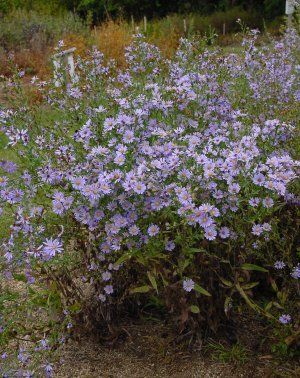
Smooth Aster,
Symphyotrichum laeve (aka Aster Laevis)
to my surprise these starting blooming all over the dirt field. I'm keeping
them. They remind me of the asters I grew in Colorado. I've
seen butterflies & bees fluttering over them.
My research shows that they aren't picky about soil types and moisture levels.
If I cut them back in early June, it will make the plants bushier and I can
control the height & shape. Time will tell if they come back in 2012 -
they certainly had lots of seed.
|
 |
|
|
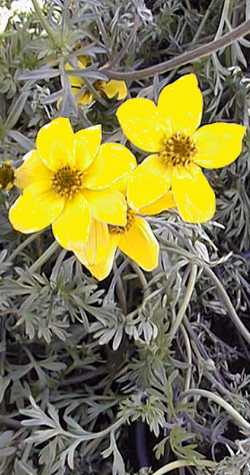 |
Apache Beggarticks (Bidens
ferulifolia):
What a surprise when these showed up in
the dirt field. Yes, they are weed, but I did not pull there. The yellow
flowers have a slight fragrance. I let them go to seed and planted the seeds
throughout the garden. |
|
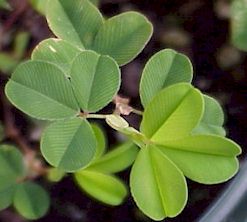
Clover:
White clover is a perennial with trifoliate leaves, stems that root at the nodes, and
white flowers. Leaves are composed of 3 leaflets (trifoliate).
Haven't seen much clover here.
Read this:
Removing the Clover from Your Lawn? Don't! |
 |
|
| |

|
Dandelion:
The dandelions have long thick tap root. I certainly try to pull up the dandelions
before they go to seed. When I was a kid, much to my Daddy's dismay, I loved to blow
the dandelion seeds.
Not many dandelions in the field of dirt. They
sure were prevalent in Denver. Bought a fancy weed puller at Lowe's. It
works really well on the big ones, not so much on small ones. If you don't pull
up most of the tap root, the weed comes back. |
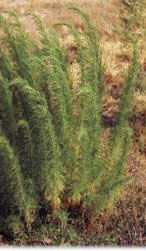
Dogfennell:
A perennial with finely dissected leaves that may reach 6 1/2 feet in height. Seeds
are oval, and are without hairs. The first true leaves are opposite and
subsequent leaves become finely divided like those of the mature plant.
Have plenty of this, you want some?
|
 |
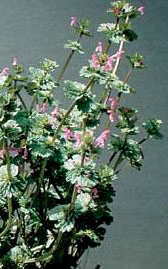 |
Henbit: Henbit
is a winter annual with square stems and pink-purple flowers, reaching 16 inches in
height. Its leaves are opposite, reaching 5 inches in length, circular to
heart-shaped, with hairs on the upper leaf surfaces and along the veins of the lower
surface. Leaf margins have rounded teeth. Stems root at the lower nodes, are
square in cross section and are covered with downward-pointing hairs. Flowers are pink
to purple in color and are fused into a tube approximately 2/3 inch long.
This is actually quite pretty in mass. Left
it alone for a while, but now it is all gone too.
|
Plantain:
Plantain is a perennial. It grows in a basal rosette with broad oval leaves. Its roots
are fibrous with a strong taproot. Its leaves are smooth or slightly hairy, oval to
elliptic, with a waxy surface and veins that are parallel to the margins. Margins are
untoothed and sometimes wavy. Flowers produced on unbranched stalks (scapes) that
arise from the rosette. Flowering stems are 5-15 inches long, clustered with small
flowers that have whitish petals and bracts surrounding the flowers.
Yep, got this one. It's bye bye too. |
 |
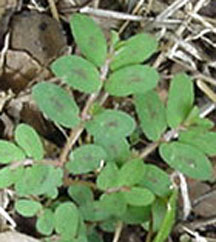 |
Spotted Spurge:
Spotted spurge is a summer annual. Spotted spurge has a more erect growth habit than
prostrate spurge. Its leaves are small and oblong shaped with an irregular red to
purple spot in the center. The leaves that grow opposite on the stem. Spurge contains
a milky sap in the stem. The Flower of spotted spurge is small and green in color. It
germinates in mid spring and flowers from June to September.
This is impossible. It is everywhere and spreads
like crazy. The battle continues. |
|
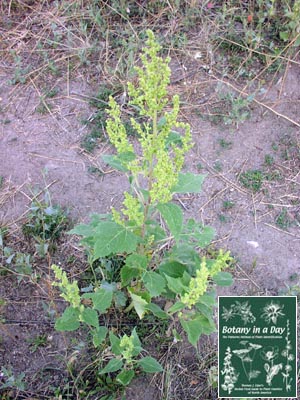
Giant sumpweed (Iva xanthifolia)
It is often found growing in or around livestock pens. This growing
everywhere in the yard. I don't find it attractive, so out it goes. I
tried to pull it before it set seed. Hopefully I was successful.
|
 |
|
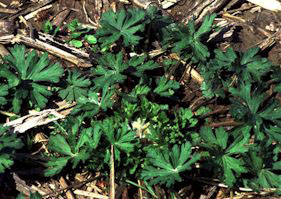
Wild Geranium:
Wild geranium, also called Carolina geranium, is a semi-erect winter annual. The
erect stems are branching and covered with hair. The alternate leaves are on
long petioles and are divided into segmented leaflets which are blunt toothed.
The flowers have 5 white to pink petals and form in clusters. The seed forms in
a fruit capsule that forms a "storks bill". |
|
|
GRASSY WEEDS |
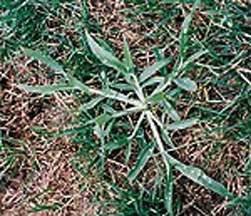
Crabgrass:
Crabgrass is a summer annual that germinates when soil temperatures reach a consistent
55 degrees F and is generally killed at the first frost. Crabgrass leaves are rolled
in the bud; the first leaf appears short, wide and blunt-tipped. The ligule is tall
and membranous with jagged edges, and the auricles are absent.
This is everywhere - don't think I will be able to
get rid of all of it, but I'm trying. It has burs that stick to your clothes/ |
 |
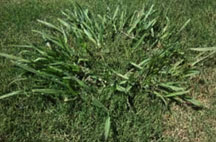 |
Dallisgrass:
Dallisgrass is a warm season coarse perennial which is light green in color. The
leaves are rolled in the bud, flat and wide (1/2"). Auricles are absent and the ligule
is tall, pointed, and membranous. Dallisgrass has hairs on the lower portion of the
leaf near the ligule. The seedhead contains 3 - 6 spikes, with seeds on both sides of
the spike. Dallisgrass can from short thick rhizomes, but spreads upright in clumps.
This was thriving in the yard of the rental house.
Easy to pull up young plants, but once established it has to be dug up - will leave
that task to the landlord. Fortunately I don't see it on our property. |
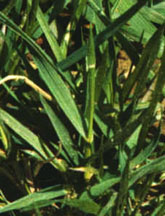
Fescue:
Tall fescue is a deep rooted, cool season perennial grass. Tall fescue does produce
short rhizomes but has a bunch-type growth habit - it spreads primarily by erect
tillers. Leaf blades are glossy on the underside and serrated on the margins.
How do these get started - I mean the yard invasion? |
 |
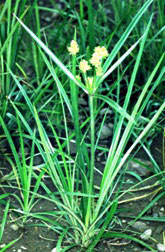 |
Nutsedge:
Sedges have triangular stems with waxy grass-like leaves which alternate. Sedges are
not grass plants, but seedlings may be mistaken for grass. The leaves on both sedges
are waxy and have an up right growth habit and a prominent midrib. Both sedges have
underground root systems containing rhizomes and underground tubers which accomplish
most of the reproduction. On yellow nutsedge, the tubers (nutlets) form at the end of
whitish rhizomes. Purple nutsedge forms chains of tubers along brownish rhizomes. The
flowers of yellow nutsedge are yellowish; the seedhead color of purple nutsedge is
red-purple to brown. Both seedheads are on triangular stems. Both spread mainly by
germinating underground tubers, which are the only part of the plant that
over-winters. A yellow nutsedge tuber can produce 1,900 plants and 7,000 new tubers in
a single growing season. Sedges do well where soil has poor drainage. |
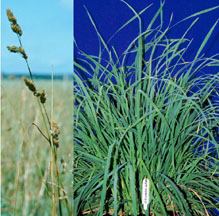
Orchardgrass:
Orchardgrass is a perennial grass that is blue-green in color. The leaves are folded
in the bud, the ligule is very tall membranous, and auricles are absent. Orchardgrass
only contains tillers, resulting in clumps. Orchardgrass can tolerate close mowing.
The roots are very fibrous and dense. Orchardgrass remains green throughout the year.
The seed head is a stiff-branched panicle. Seed heads occur from late spring through
mid summer.
This has to be dug up. It is pretty but has to
go. |
 |
|
|
|
|
|